

Our Strategy to 2035
Place to belong
Our Strategy to 2035 will help us keep the focus on what we do best - giving young people a place to belong and giving them the skills to thrive.
Find out more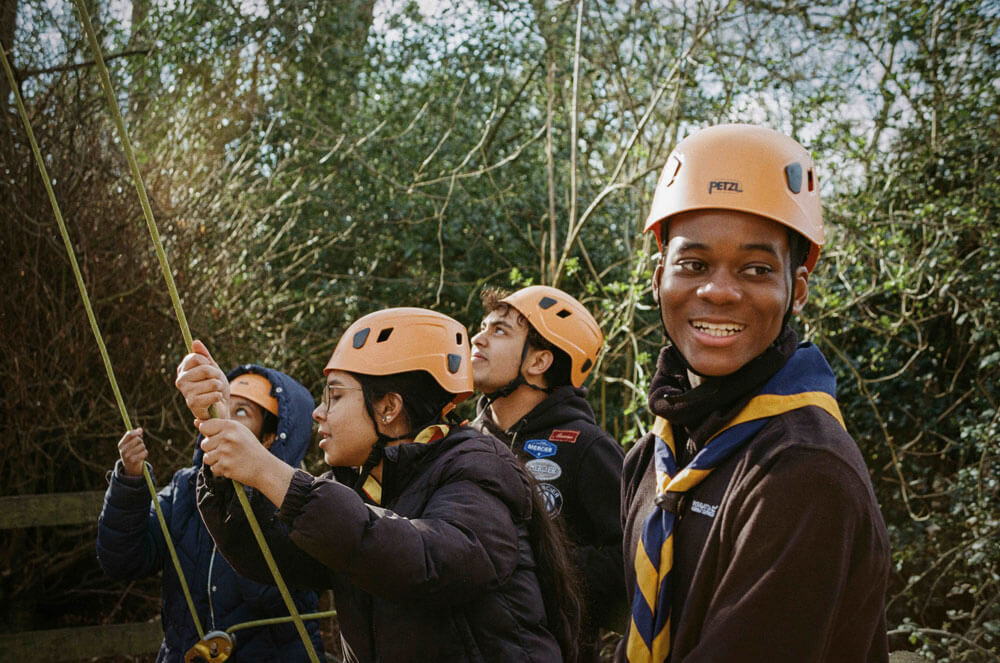
The lugger’s role in the van crew is to carry or drag trees from the customer’s houses to the van and pack them in. The more trees we can cram into a van, the faster the collection runs, but it depends very much on the size of the trees. The vans will carry anything from 15 very large trees to 30 smaller ones.
Usually the driver, navigator and lugger on a van work as a team. When the van arrives at a street with lots of trees to collect, everyone often jumps out and helps to find the trees and drag them back. At the very least, it is useful if someone hops out and opens the van doors while the lugger finds and brings the tree to the van. If you are not getting the help you need from your crew, ask! If you find a tree is too heavy to easily move by yourself, ask for help! Do not attempt anything that might result in injury.
At the collection site, trees need to be dragged out of the van and stacked neatly for processing. Any tags, decorations, etc. need to be removed.
On Saturday, we are running two four-hour shifts (8am to 12 and 12.30 to 4.30pm), with one lugger per van. On Sunday, we are running a single longer shift, but with two navigators per van. You need to agree with your driver (and team) who will take the early shift and who will take the second half of the shift. We can also be somewhat flexible on the timing of the Sunday shift, but expect to have to collect for around 5 hours in total.
The collection site will have hot food and drink.
Safety is our top priority. After that, the main focus is accuracy. Your navigator will know what addresses have ordered collections, and how many trees we have to collect. It is very important that we collect all the trees that have been ordered, but no others. There may be many trees out for collection; only some of them are ours. We must collect ours, and no others. If there is any doubt, err on the side of caution, and consult your navigator.
We can only take trees. No Christmas wreaths or other items that might contain wire or nails. Trees with a circular wooden base are fine. Rooted trees in pots are not. We can saw off and take the tree, and leave the pot. Each van should have a hand saw; sometimes very large trees may need to be cut in half for efficient loading.
The site has a large area of hard standing on which vehicles can be driven, although it has soil and vegetation on top and can get very muddy. A concrete kerb forms the boundary between this and an open field, on which vehicles cannot be taken. We can stack trees on the field along this kerb line and also along the opposite side of the hard standing area, leaving a gap for vehicles to reverse and turn. Trees should ideally be stacked fairly neatly. The site may have to accommodate up to 2000 trees – ours and those collected by Princess Alice Hospice. Our trees may need to stacked some way back onto the field, and be banked three or four trees deep. We need to leave the entire hard standing area clear for the large vehicles that will eventually process and remove the trees.
It is very important that the trees are cleaned of all decorations, plastic tags, scraps of nylon netting, or anything else that is not natural. Some trees will have plastic tags at the bottom and may also have cable ties that were used to secure the netting they were delivered in. If our shredded trees are found to contain plastics they may have to go to landfill and we will face a financial penalty. If a tree is contaminated with tinsel etc. put it to one side for cleaning or separate disposal.
You will need to wear gear appropriate to the weather. Unless we’re very lucky, it will be wet, and even if it isn’t raining, trees left out overnight may be wet. Unless the ground is frozen solid, the collection site will be very muddy. Bear in mind that it may be cold, but you are likely to get quite warm with the exercise! We will provide a high-visibility jacket, which you should wear for safety, but this is just a thin layer.
Our Strategy to 2035
Our Strategy to 2035 will help us keep the focus on what we do best - giving young people a place to belong and giving them the skills to thrive.
Find out more